Showing posts with label review. Show all posts

Friday, 5 January 2024

Film: The Way We Were, with Barbra Streisand and Robert Redford

I realise that most of my secretsquirrelsays reviews are negative with the exception of some books about Frank Sinatra and a couple of single episodes of TV series, such as Law & Order: Skate or Die and Cold Case: Honor. For some reason, I am easily provoked to ridicule and criticism by bad media although admittedly some of the films do fall into the 'so-bad-they're-good' category, eg Ferocious Planet and Dark Storm

So, now for something completely different. For some time now, Sony Movies Classics has been showing The Way We Were (dir. Sydney Pollack, 1973), the Barbra Streisand/Robert Redford masterpiece, with the heart-rending theme (music by Marvin Hamlisch, lyrics by Alan and Marilyn Bergman, sung so beautifully, emotionally, by Ms Streisand) and I've been torn between a) really wanting to watch it again but being frightened it might be too upsetting and b) avoiding it in case I found it disappointing. I must have watched it on TV I don't know how many years after it was made. Finally, I took the plunge and this review is the result.

Incidentally, Hamlisch also wrote the music for The Sting, another Redford vehicle and Pollack also directed Redford in Out of Africa, which had its own hauntingly pretty theme by the unsurpassable John Barry. 

What can I say? They simply don't make movies like this any more. I realise that's American speak (and they would also make ‘any more’ one word, which is simply wrong) and I should write 'They no longer make movies like this' but it just doesn't have the same oomph. And they don't make movie stars like this any more either. All of it is perfect. But let's start with the song. From the first notes on the piano, Barbra humming, within seconds, my sister and I are in floods of tears. Transported to a different time. We nearly have to give up watching, we're so distraught. Some people will know the Gladys Knight version of the song but that's about as different as you can get. When Barbra sings 'If we had the chance to do it all again/Would we?/Could we?', the 'Could we?' is a teasing, genuine proposal. Why not?


This is the power of music, the power of film, whose effects, when combined adroitly, as they are here, and in Born Free (John Barry again) and A Summer Story (Georges Delerue), increase exponentially. Even, I don't know, ten/fifteen years since we last watched it, it's so laden with our memories of watching the film, the first time, the last time, the incredible love affair, knowing the progress of it and its denouement, what we know happens in the film and everything that has or hasn't happened in our own lives in the intervening years, all the way through to Carrie (Sarah-Jessica Parker) and Mr Big (Chris Noth) in Sex and the City, when Carrie quotes Barbra as Katie: 'Your girl is lovely, Hubbell.'

This is evidence of how pervasive, persuasive, this type of storyline is, how it's repeated in other dramas, that most of Carrie's friends immediately know what she's referencing although I think it does have to be explained to one if I remember correctly. The characters and the situation have entered a sort of universal lexicon of love stories. It is a love story, and unashamedly so. A rom without the com.

Ok, Redford and Streisand as college students when she was 36 and he over 40, is a bit of a stretch.

BUT Barbra Streisand is simply outstanding as Katie, utterly on point throughout. I don’t think anyone else could have played this part. She has the mix just right and her face is so expressive. Rumour has it that she had a crush on Redford at the time, which could only have helped.

And Redford is perfect for Hubbell, embodying the all-American male, preppy, what we would now call WASP, a jock, a prom king type (with his queen played by Lois Chiles), for whom 'everything comes easy', as he tells it in a story he wrote that he is forced to read out in class. This type of character has become part of Redford's persona. Jocular, witty, warm but also a little too perfect to be approachable. His charm is effortless, his charisma magnetic.

Incidentally, also re-watched Redford in The Great Gatsby (a 1974 adaptation of the F. Scott Fitzgerald novel), in which he plays, on the surface, a similar type, and this I found incredibly tedious. The characters are unremittingly shallow.

My favourite part of the movie is the motif that recurs when they re-encounter each other. A deja vu shot of a particular gesture. Katie reaches to guide Hubbell's fringe out of his eyes with such tenderness and love. The first time is before anything has begun between them, the second near the end of the film. Their relationship has died but the affection they feel for each other remains. 


This film does what Evelyn Waugh's and TV's
Brideshead Revisited did so consummately, conjures up nostalgia for a certain relationship and a certain time. The days of our collective youth, whenever they occurred. Think E. M. Forster's Maurice (the book and the film) and this sentence from the last page.

"Out of some eternal Cambridge his friend began beckoning to him, clothed in the sun, and shaking out the scents and sounds of the May Term."

It's what I call a 'what-could-have-been' moment. A dream, a fantasy. A road not taken.

* * * *

[Arthur Laurents adapted his own novel for the screenplay and the film is also about politics, the fear of Communism, manifesting itself in the blacklist; the HUAC and activism but a bit like Hubbell, you can tire of causes, however worthy. It's still a love story first and foremost.]

Wednesday, 5 May 2021

Book: Flight Behaviour by Barbara Kingsolver

I've got to admit that this book was a bit of a disappointment after The Poisonwood Bible, which I loved. In fact, the title itself is a little off-putting. It certainly doesn't grab you - Flight Behaviour. Something seems to be missing and this is the case with the book too. I ended up feeling short-changed. First of all, I thought the beginning was excellent and was excited at the prospect of Dellarobia's affair so I felt a little misled when that didn't materialise. I have a feeling that this young man would have been the most interesting character.

Then I gradually lost respect for and belief in the protagonist and don't feel she was
 very well realised. I would have liked to identify with her but too often, things are signposted in advance and she behaves in a weak or childish way, for instance when she first encounters Ovid Byron and talks to her friend Dovey about him. They sound like tittering teenagers. Then when he comes to the house and she and Cub talk up her expertise on the butterflies. You know that Byron is going to be the real specialist. It's too obvious. And it seems out of character to drag the reporter into Byron's lab without any warning.


The other thing I'd take issue with is the way she seems to first recognise how many toys her kids have in comparison to Josefina but then bleats on about having to shop in the dollar store or the new second-hand emporium. It seems she has no perspective. She resents people shopping there who she thinks could afford to shop elsewhere and pay full price and the implication is that, if she had the money, she would rather not economise. What's wrong with buying nearly new stuff at rock-bottom prices? I would love to find this store. She's not exactly hypocritical but inconsistent and full of self-pity, not particularly attractive traits.

I applaud her stand on the butterflies and have nothing against the message of the book. I only think that more time should have been spent on characterisation and dialogue. Her exchanges with Dovey don't ring true at all and Ovid is not well drawn enough to be convincing so ends up as merely a cipher, the scientist from somewhere exotic to Dellarobia. 

Wednesday, 4 October 2017

Film: 12 Hours to Live (but believe me, it’ll seem longer …)

Ione Skye in Say Anything
When Ione Skye starred with John Cusack in Say Anything in 1989 (a film I missed first time around), I felt sure that she would either be discovered as an impostor and swiftly returned to whatever perfect mould she originated in, would learn how to act or would realise that acting wasn’t for her. A beautiful girl, she should perhaps have gone into modelling but no, many years later, I had the misfortune to witness her ‘talents’ once more.

Kevin Durand as Keamy in Lost
Poor Kevin Durand, an actor I had liked in the minor role of Martin Keamy in a couple of episodes of Lost. For more on Lost, see Opinion8: Must-see TV. He’s a big guy, 6’6” I believe, and is often sidelined or pigeon-holed into roles as over-sized aliens (eg in I Am Number Four, a film that also wastes Timothy Olyphant as a sidekick to an unappealing teenage hero) or mindless villains, because of his physique and never really given a chance to show what he can do. Now, finally, he gets a lead role. And what does he have to play against? A plank of wood. My sister reminds me when watching this, that someone on Freecycle (a UK website on which you can give away items you no longer need that others might find a use for or request something you need that someone else might no longer need) was asking for attractive pieces of wood and Ione Skye fits the bill. She’s so bad in this that it’s painful to watch, worse to listen to. Her voice throughout is completely affectless, evincing no emotion, no meaning. It’s all totally flat, as if she were reading the phone book. If she were a piece of music, she would be atonal. This seems to rub off on the rest of the cast. The sheriff says his lines as if he were rehearsing with someone, merely giving them their cues. Even Michael Moriarty (as Ione’s father), who I’m sure has been good in the past, can't really be bothered.

'Please, no more scenes with Ione!'
It’s not helped by a ridiculous script, which has Ione’s FBI agent (in pursuit of Kevin Durand's criminal fugitive, Lowman) at odds with her father although no reason is given while at other times we’re subjected to some horribly on the nose dialogue to explain some character’s motivation and, as if things weren’t bad enough, a series of flashbacks featuring Ione failing to render any readable emotion. What do the filmmakers have against us? It's like torture. At one point, Ione declares 'I know where he's going' but doesn't bother to tell anyone and goes after him alone. Or maybe the the other actors refused to accompany her in case it meant they would have another scene with her.

Why does Lowman (our Kevin) take the girl (Brittney Wilson does her best with this underwritten part) with him? – it's more trouble than it's worth. When asked for a reason, even he can't come up with one. There’s no plausible rationale for this so we have to assume this was done to inject (see what I’ve done here) drama and conflict in the story by sticking in (and here) a time-sensitive diabetic-needs-her-insulin thread. In fact, no explanation is given for his past misdeeds either.

12 Hours to Live
But, despite all this, Kevin Durand still manages to create a convincing character, bad but by no means all bad, sympathetic if not simpatico. Even his hostage starts to root for him a little. He acts the rest of them off the screen and does not allow himself to get distracted by the flaws in the script or the other players’ ineptitude or lack of commitment. He becomes Lowman in every mannerism, mood, movement, expression. He’s invested him with humanity. Kudos to Kevin. It’s just a shame that he gets to shine in such substandard material because his performance is so believable, so totally on point. I can only hope that any casting director can see past the entirety of this terrible film and recognise the deftness and skill of his portrayal, how he’s transformed the two-dimensional template he’s been given into a three-dimensional anti-hero.

For more on acting, see john malkovich as the 'unfathomable' gilbert osmond in 'the portrait of a lady', helmut berger as konrad in visconti's 'conversation piece' and peter quinn (rupert friend) in 'homeland' on channel 4.


Friday, 3 March 2017

Play: Wish List* by Katherine Soper at the Royal Court Upstairs


The Royal Court
* Not to be confused with either of the two Hollywood romcoms with similar titles. There's a pretty good chance that, if you liked them, you won't like this.

Joseph Quinn and Erin Doherty
I cannot commend this highly enough. Affecting, involving, authentic. The script (Katherine Soper's debut, it won the 2015 Bruntwood Prize for Playwriting), the playing, are so close to real life, that you don’t feel like you’re watching someone act at all, you feel like you’re watching someone be. The dialogue has all the cadences of natural speech. There’s no staginess, no showpiece monologues, no extra words, unlike The Pitchfork Disney, which I saw a couple of nights before, a play that touches on similar subjects (brother/sister dynamic, [co-]dependence, mental health problems) but is an actorly piece using shock tactics (and admittedly some humour and sexual innuendo), requiring the actors to deliver lengthy monologues to express their strange foibles and predilections. Wish List shocks profoundly, simply, without verbose explanations.

Dead ordinary and all the better for it
Tamsin is a whole character (a person not an ideal or a symbol). She’s painfully real, not given to any particular eloquence, which is not so say that there’s nothing eloquent in the play. The entirety of the play – the performances, writing, staging – add up to an everyday eloquence.  Her battle with the benefits system on behalf of a brother who's practically house-bound by severe OCD is familiar to any of us who've ever had to wrangle with the bureaucracy of any imperfect system, whether it's a hospital, a council or simply Southeastern's Delay/Repay form. We rail at the hoops we have to jump through. Tamsin is heart-breakingly disappointed by her brother’s failures to help himself (and so the both of them) but ultimately reacts with patience and tolerance (greeted by the exasperated sighs of the ladies near us in the audience) in the face of each setback.

Playwright Katherine Soper
Fresh, intimate, personal but also universal. In fact, there's a theory that the more personal something is the more universal it is. Tamsin’s dilemma is conveyed brilliantly. The Meatloaf sequence is exquisite, touching, amusing, embarrassing, ultimately uplifting, a beautifully underplayed tour de force from Erin Doherty. She holds this together, her frustration articulated in a confused pause, an excited rush of words, a defeated glance.

Kudos to the rest of the cast who are all superb: Shaquille Ali-Yebuah, Aleksandar Mikic and Joseph Quinn, the last of whom I've since seen in Dickensian (London Live) as Arthur Havisham. He is somehow able to make this essentially weak and wrong man sympathetic even as we decry his sly machinations.


And of course, Erin Doherty has gone onto TV success as Becky in Chloe.

I sometimes leave the theatre feeling a little cheated, feeling that the actors did their best with a substandard script. Not so with Wish List. It’s the real deal. Even better than Rachel De-lahay's The Westbridge. The writing is tremendous. If you only see one play this year, see this one.  If you only ever see one play, see this one. And go listen to 'I Would Do Anything for Love'. Right now.


Tuesday, 12 July 2016

Book: The Golden Notebook by Doris Lessing

The book
Everybody but everybody knows other people’s dreams are boring. Why didn’t anyone tell Doris Lessing? This book is full of descriptions of her dreams and convoluted flights of fancy, which might possibly be of interest to her therapist (the excuse for some of the endless detail about them) but are tedious in the extreme for the reader. They don’t ring true and are full of glaringly obvious symbolism. I was going to type out a section from one of these dreams but started to lose the will to live. They are mind-numbingly dull. There’s a really long, involved one about an encounter with a tiger near the end of the book. Read at your peril.

(Here’s a bit I copied from a file – it’s not as dull or long as most of them: “I stood looking down out of the window. The street seemed miles down. Suddenly I felt as if I'd flung myself out of the window. I could see myself lying on the pavement. Then I seemed to be standing by the body on the pavement. I was two people. Blood and brains were scattered everywhere. I knelt down and began licking up the blood and brains.” Need I say more?)

From the book: ‘How boring these emotions are that we're caught in and can't get free of, no matter how much we want to.’
You’re telling me. If you find them boring and they’re your emotions, how do you think we feel?

The word other reviewers have used is self-indulgent and I totally agree. The whole thing needs much more careful and extensive editing. Inside this tome, there is a slim volume of merit I’m sure but its traces are so rare and obscure that it isn’t worth reading for them. An editor needed to go through this with a scythe, or whatever tool would get rid of all the chaff.

Doris Lessing
What really offends me is any notion that this book has feminist credentials or is some kind of classic of any genre at all, eg ‘Widely regarded as Doris Lessing’s masterpiece and one of the greatest novels of the twentieth century, ‘The Golden Notebook’ is wry and perceptive, bold and indispensable.’

It’s the opposite of everything feminism stands for. The women in it are totally in thrall to whichever man chooses to sleep with them. They have little volition. Unless Doris Lessing is suggesting that the fact that they are ‘Free Women’ (admittedly this term has to be ironic) allows them to sleep with other women’s husbands while remaining stalwartly single themselves. It’s all pretty pathetic.

‘Anna discovered she was spending most of her time doing nothing at all; and decided the remedy for her condition was a man. She prescribed this for herself like a medicine.’
Guess what? It doesn’t work. And anybody who thinks this is feminist in any way is seriously deluded.

Lessing says: ‘Although no one will ever believe it, I was completely unconscious of writing a feminist book. I was simply writing about what I saw.’
I believe it, Doris.

The structure comes across as an attempt to do something different for the sake of it. It doesn’t work or add anything to the novel, merely obfuscates any point the author is trying to make although I’m not convinced there was any kind of point in the first place. The idea seems to be to demonstrate her failure to communicate anything to the reader but a deep and lasting ennui as we struggle to get through her stodgy prose and endless whingeing.

If this really was seen as a ‘landmark novel of the Sixties – a powerful account of a woman searching for her personal, political and professional identity’ or as representative of any kind of feminist value or stance, it’s a sad indictment of the era. And it won the Nobel Prize for Literature in 2007!

Friday, 7 August 2015

Book: The Miniaturist by Jessie Burton


Prettily produced
I’ll start with the positive - the book is beautifully produced; the hardback has very pretty endpapers. That’s it, I’m afraid. And it only goes to prove that old adage - you can't judge a book by its cover.

Jessie Burton should be tried and convicted for this unprovoked assault on the English language. She mutilates and mangles it beyond all recognition. At first I wondered, like another reviewer, if the text had been badly translated from a foreign tongue. But no – this is all her original work and she is solely responsible – unless we consider her publishers accomplices.

Anyway, here’s the evidence.

The story, the characters, the dialogue are all completely unbelievable and unreal. The author evidently thinks that if she throws enough description at us of the sensations and sights of 17th-century Amsterdam, even with horribly inapposite similes and repetitive vocabulary (if you’re just beginning this book, count how many times she uses ‘tang’), this will lend her tale authenticity and credibility. She’s wrong.

I’m astounded by the plaudits it has received. Did these people read the same book I did? ‘The kind of book that reminds you why you fell in love with reading’. What? This almost makes me wish I’d never started to read in the first place. I thought perhaps these writers were with the same publisher so they had to promote another book from the same stable but no. They seem to be genuine if extremely generous opinions. I suggest they read ‘The Goldfinch’ if they’re partial to historical fiction. See how it should be done. And as for Richard and Judy - I've lost any respect I had for them.

We’re invited to identify with the selfish, hypocritical Nella as she whines and whinges about her lot while never sparing a thought for the servants working from dawn till dusk, except to wonder how they dare to be so familiar with her, about how everyone is spying on her even as she’s spying on them, creeping into their rooms when they’re out, slyly passing petty judgements on all around.

The plot doesn’t hold water, with all the characters so changeable in their opinions and ways that none of what they do rings true. The dialogue is like a schoolgirl’s pitiful attempt to replicate ‘olde worlde speak’. And this is what this book is – it’s not historical, it’s olde worlde – in other words a poor imitation, from start to finish. More a cut-price Downton than Jane Austen. It might fool readers who think it’s a touch more intellectual than their normal diet of chicklit but it’s insubstantial fluff.

First, I was beleaguered by her poor grammar and misuse of vocabulary: ‘Most of the sugar has not yet sold’ and ‘… books were not much subject to government censorship …’

Or ‘without the miniaturist and her quality so elusive’
She means that she’s elusive not her quality, that she has an elusive quality but this isn’t what she’s expressed.

‘Perhaps the miniaturist will send her something soon to elucidate this strange woman.’
You can't use ‘elucidate’ like this. It’s an intransitive verb. It can't have an object.

‘… she feels differenced …’
What – are we gonna get French about this and make up our own words?
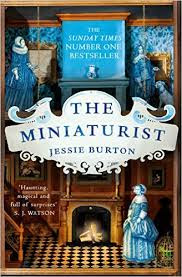
The front cover
The book is rife with nonsensical sentences that Jessie feels have meaning. They’re words, strung together, that’s all.
‘Love a beam of sun which sometimes clouds the heart.’
What? A beam of sun can't cloud; something passing in front of it will cause a shadow perhaps; or a cloud can pass over the sun.

Of Marin, Nella thinks: ‘What lies beating in that carefully protected heart?’
It’s the heart that’s beating, you idiot.

And ‘That ink was secret nectar, for Marin isn’t married.’
Why is it secret nectar? For whom? What does this mean? Does it mean it’s nectar for Nella because she’s got one over on Marin? Or does Burton just think this sounds poetic?

The dialogue is especially clunky as Burton hazards a guess that perhaps someone Dutch and from the past would phrase sentences differently. Yes, probably, but not like this. This is the sort of stuff we’re dealing with and it ain’t pretty.

Marin: 'How it looks, that Johannes does not come to church.'
How it looks? Ouch.

Nella to Meermans: ‘Is it worth killing your friend for guilders?’
So poorly expressed. But she wanted to get the actual currency in there somewhere even though any normal person would just say ‘money’.

Mystic Meg
Much of the time, the author is trying to sound portentous but failing miserably, ending up with Mystic Meg-type claptrap (eg ‘Beware the look of love from someone wearing blue’, no offence meant, Meg). When her characters attempt gravitas, it falls flat and often what they say is illogical, irrelevant or both, eg Johannes defending himself against a charge of sodomy.
Johannes: ‘Schout Slabbaert picks on my African servant, a man from Dahomey. Does the Seigneur even know where Dahomey is, as he drinks his sugared tea or eats his little buns?’
No – and why should he and what difference would it make? What’s his point? That he should be let off because he’s well travelled? I’m not sure that’s a recognised defence. That Meermans’s testimony should be ignored because he has sugar in his tea and eats buns?

Johannes again: ‘Franz Meermans criticizes my freedoms but suffers no guilt enjoying his own. Find a map, Seigneurs, and learn.’
Why? What’s the relevance? The point is that he’s been caught doing something illegal so it doesn’t really matter how good he is at geography or how bad they are.

Johannes to Jack: ‘You are a stone thrown upon a lake. But the ripples you create will never make you still.’
Huh? Why would ripples ever make someone still? She doesn’t seem to think before she writes this stuff down.

Johannes: ‘What is the game you are playing? When will it be my turn to ask questions? You have sought to defame me and shock the crowd. I must have my say.’
What is the game you are playing? Why not ‘What game are you playing?’ This is so dire. And why does she assume that Dutch people’s speech, once translated into English, would have no contractions? Johannes ends up sounding like a two-year-old having a tantrum.

Nella: ‘You imperfect men, dressed in borrowed glories!’
This is her grand retort to the guards who come to look for her husband. Just more awkwardly phrased, meaningless drivel.

Johannes: ‘It is customary that the accused may speak.’
I’ll say it again so you can hear how bad this sounds: ‘It is customary that the accused may speak.’

‘Death is hovering in the air, hinting at them all, its terror or its bliss beyond.’
Oh, I can't be bothered.

Her cute perkiness began to irritate me
The further I got into the book, the more critical I became. I don't know if it got worse or if I just lost the patience I started out with.

The plot doesn’t follow and the author doesn’t attempt to explain why, for instance, the miniaturist’s father suddenly appears on the scene. Yes, he got a letter from Nella but it was one of many he received.

The dialogue exchanges are priceless though.
Cornelia: ‘Why has God punished us, Madame?’
Nella: ‘I don't know. He may have posed the question but we are the answer, Cornelia.’
No – in fact, Cornelia just posed the question. God didn't ask anything. To what question that God asked are they the answer? Answers on a postcard, please. Nella, this is what happens when you attempt to be profound. Please, please don’t do it.

Johannes: ‘I sometimes wonder, if I sit very still in here, if I have already died too.’
Nella: ‘You are alive, Johannes. You are alive.’
Johannes: ‘A strange world. Human beings going around reassuring each other that they haven’t died.’
Strange indeed. Is this supposed to make sense or be touching in some way?

The doll house
The book is full of illogical sentences, which I think are Jessie Burton's assays at depth.
‘Nella is still too astonished to say much, but she’s been in Amsterdam long enough to know one barters as soon as breathes.’
So why is she so astonished then?

‘They say that watchers are always watched in Amsterdam even those who cannot see.’
Hmm. How can they watch if they cannot see?

‘We’ll need … a stick for me to hold my teeth upon’.
She’s not holding her teeth on a stick; she isn't taking them out and putting them on a stick – she’ll be biting down on a stick.

'Complacent, pleasure, body – these forbidden words give the people in the chamber a thrill.’
Since when are these forbidden words? Why would anyone get a thrill from the words ‘complacent’ and ‘pleasure’?

One of the youngest children, no more than three years old, stares between the banister spindles in horrified wonder.
This child is supposed to be reacting to the word ‘sodomized’. Forgive me for thinking that a child of three or under might not be familiar with this word.

Nella is also prone to irritating flights of fancy, which are possibly meant to be endearing but are really simply infantile.
Nella to the miniaturist: 'Madame, send my husband a pair of wings. Fly him faster to the departing ships.'
What’s the point of this? No one can attach wings to him and allow him to fly.

Quite often these are supposed to be funny but there’s always something snide and critical underlying them.
‘She imagines her sister-in-law stringing her up on one of the ceiling beams, pattens falling off her swinging feet among the feathers, her cold body warmed by poetic sunlight …’
Well, actually we’re all hoping for this. ‘Poetic sunlight’ – what’s that when it’s at home?

‘Nella wonders where Marin’s husband is. Maybe she’s hidden him in the cellar. She smothers her desperate impulse to laugh …’
Why – it ain’t funny.

‘She whirls round – is the miniaturist here in the room, hiding under the bed? Nella crouches to look …’
Oh come on. Even Nella’s not that stupid!

Anyway, I rest my case. Tried and convicted. Unfortunately, it looks like Jessie Burton will be rewarded instead of punished for her crimes. She should at least be forced to read some better fiction.


To check out my reviews on Amazon, follow this link.


Sunday, 26 April 2015

Film: Joy Division


Perhaps I should have been warned by the banner across the top of the box ‘THE PAST IS A PLACE YOU CANNOT ESCAPE (so profound) and the fact that the only praise longer than one word they have is from something called Boys Toys (not as bad as it sounds), who proclaim ‘SEARING WARTIME SET-PIECES’. The latter at least is true.

Here’s an edited synopsis: ‘In the last days of World War II, a teenager is forced into battle against the advancing Red Army … he is captured by the Russians and disappears behind the Iron Curtain … 17 years later, he is recruited … and sent on a mission by the KGB to London’.

Bought this because Tom Schilling was in it but have to agree with the other reviewers – his bits are excellent, the German back story is the only watchable part, mostly because of his natural, effortless, sympathetic performance and far more credible and moving than the 60s spy episodes. They should have expanded this to movie length and completely cut the 60s section.

This film was written and directed by Reg Traviss. There’s a reason this guy’s not a household name and this movie could be it. First, he’s cast Ed Stoppard (no relation to Tom or Miriam – oh wait, yes, he’s their son; nothing like getting a part on merit, and this is nothing like it). His lines are delivered in an affectless tone, reminiscent of Keira Knightley at the wooden beginning of her career, with one of those irritating schizophrenic accents British people adopt to please Americans, often heard in US teen drama, such as Dawson’s Creek and One Tree Hill; for the first half of a sentence, they sound as if they’re in Downton, for the second half, they sound like they’re in EastEnders, i.e. posh then common. No one in England really talks like this. And whereas everything Tom Schilling does is finely nuanced; Ed Stoppard’s a blunt instrument and he doesn’t have the charisma to carry a weak storyline.

Then, if he started as German, then went to live in Russia, why doesn’t he speak English with a foreign accent? It has to be pointed out that Tom Schilling is way more convincing in a second language than Ed is in his first. It would have made more sense (since Schilling was playing 10 years younger than his actual age), to age him a mere 7 years and allow him to play the older version too. At least there would have been a consistency as far as accents are concerned.

The story and script are dire. The 60s spy plot is stultifying (consisting of Ed waiting on a succession of benches to rendezvous with other spies), though they try to spice it up by adding Michelle Gayle (not really known for her acting and this isn’t going to help) as a supremely uninteresting love interest. They both like art so they fall in love. It’s as bland and as undeveloped as that but no doubt Reg thought it represented a real meeting of minds.

There’s a very irritating cameo from Bernard Hill as a disaffected Communist who spouts tripe like: ‘Are we the leaders? Or are we the led? Or are we neither?’ which must pass for deep in Reg Traviss’s world and Ed’s too as he responds ‘It’s a lot to think about’. No, it ain’t. Who cares?

Worse than all this though is the voiceover, which is another attempt to be deep, with Ed delivering such pearls of wisdom as ‘strength through experience to again become strong’. Hmm. This doesn’t mean anything. Or ‘the unstoppable force of nature swept through my heart’. Neither does this. But Reg is fond of ‘unstoppable force’; it crops up more than once.

Don’t go thinking this has anything much to do with either the Joy Division of the Nazis or the band of the late 70s. If only.

My final verdict is that there’s just about enough Tom Schilling to warrant any fan of his watching this movie. The girl (Bernadette Heerwagen) is excellent too.

For more on Tom Schilling, see my poetry blog schillingspiration.


To check out my reviews on Amazon, follow this link.